

Introduction
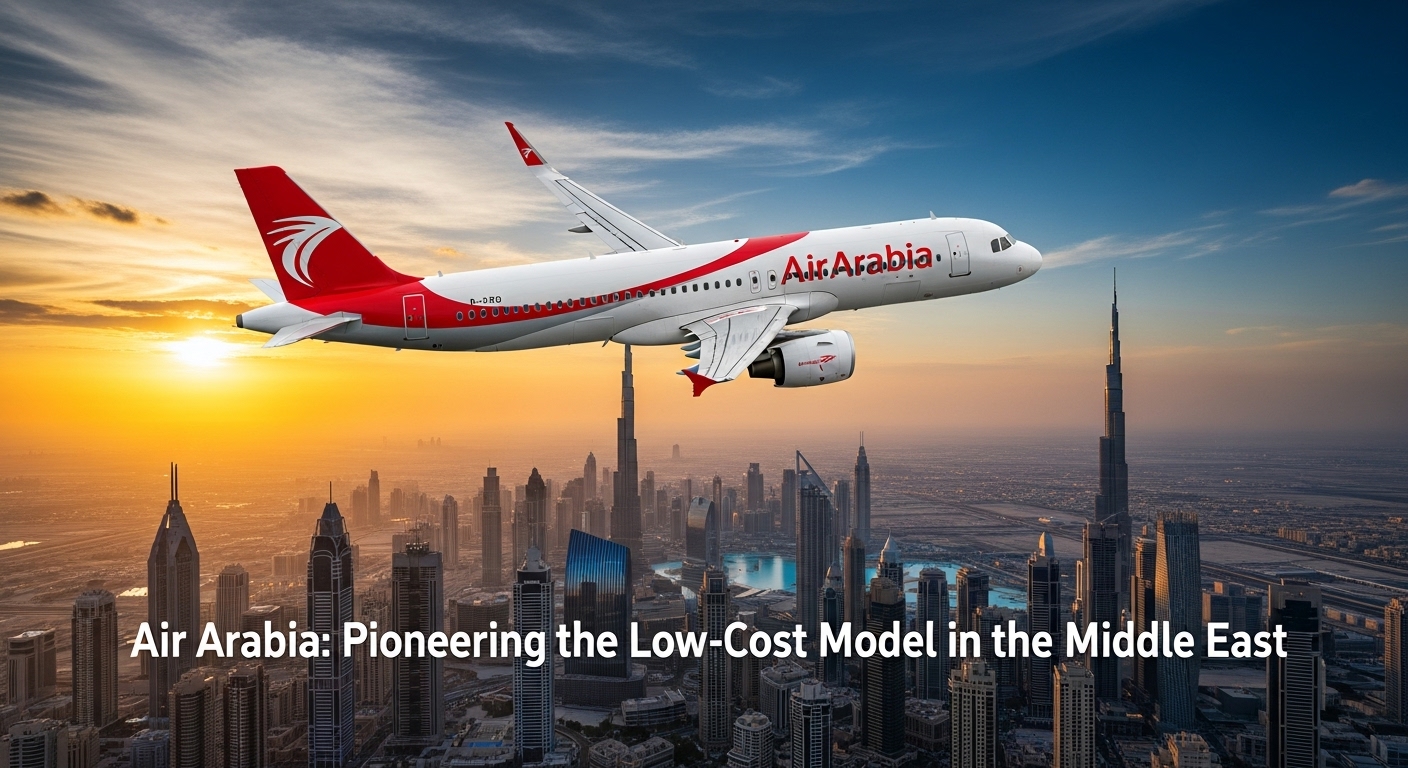
While the world marveled at the luxury and scale of Emirates and Etihad, a quiet revolution was taking off from Sharjah that would democratize air travel for millions in the Middle East and North Africa. In 2003, the same year Etihad was launched, Air Arabia began operations as the region’s first and largest low-cost carrier (LCC). Its mission was simple yet transformative: to make flying affordable and accessible for a vast population segment for whom air travel had always been a luxury. By adapting the successful budget airline model to the unique dynamics of the region, Air Arabia unlocked a massive, untapped market and fundamentally changed the travel habits of a generation.
History
Air Arabia was established by an Amiri decree issued by His Highness Dr. Sheikh Sultan bin Mohammed Al Qasimi, the Ruler of Sharjah. Its first flight took off from its Sharjah hub to Bahrain in October 2003. The timing was strategic, coinciding with a regional economic boom and a growing, young population with a desire to travel. Led by its charismatic Chairman, Sheikh Abdullah Bin Mohammed Al Thani, and CEO Adel Al Ali, the airline grew steadily and profitably from the outset. It avoided the debt-fueled expansion of some competitors, instead focusing on a disciplined, route-by-route approach to building its network, primarily targeting middle-income travelers in the MENA region and the significant expatriate labor force in the Gulf.
Key Features
Air Arabia’s success is built on the core principles of the low-cost carrier model, tailored for its market:
- Point-to-Point Network: Unlike the hub-and-spoke models of Emirates and Etihad, Air Arabia primarily operates point-to-point flights, often connecting secondary cities that were previously underserved or required expensive connections through major hubs.
- Cost Control: The airline maintains a lean operation with high aircraft utilization (quick turnarounds), a single aircraft type (the Airbus A320 family) to reduce training and maintenance costs, and direct sales through its website to avoid commission fees.
- Unbundled Fares: Passengers pay a low base fare for a seat and then can choose to pay for extras like checked baggage, in-flight meals, and seat selection. This allows budget-conscious travelers to control their spending.
- Strategic Hubs: While Sharjah is its main base, Air Arabia has cleverly established hubs in other strategic locations like Casablanca, Morocco (Air Arabia Maroc), Alexandria, Egypt (Air Arabia Egypt), and Ras Al Khaimah, UAE, to tap into different regional markets and circumvent political restrictions.
Cultural Significance
Air Arabia’s impact was profound on a socio-cultural level. It effectively ended the monopoly that legacy carriers held on the skies, making it possible for middle-class families, students, and migrant workers to travel home or on holiday by air for the first time. It strengthened familial and cultural ties across the Arab world and beyond, making weekend trips between, for example, Egypt and the UAE, a common reality. The airline became a symbol of pragmatic, accessible modernity, contrasting with the opulence of its full-service counterparts. It proved that a successful, modern Arab enterprise could be built on value and efficiency, not just luxury.
Modern Relevance
Today, the Air Arabia Group is a formidable aviation holding company with several subsidiaries, demonstrating the robustness of its model. It has expanded its fleet with orders for the latest, fuel-efficient Airbus A321neo aircraft and has launched a joint venture with Etihad, “Air Arabia Abu Dhabi,” blending its low-cost expertise with the capital’s strategic network. In a post-pandemic world where price sensitivity is higher than ever, Air Arabia’s value proposition is incredibly strong. Furthermore, by making air travel more affordable, it contributes significantly to the UAE’s tourism sector, attracting a different segment of tourists who might then spend their money in the country’s economy. Its model is now being emulated by other regional players, validating its pioneering vision.
Conclusion
Air Arabia may not have the glitz and glamour of the region’s flag carriers, but its impact on the aviation landscape of the Middle East has been just as revolutionary. It proved that the low-cost model was not just a Western concept but could be brilliantly adapted to the demographics and geography of the Arab world. By making the skies accessible to all, it fostered greater regional connectivity, stimulated economic activity, and empowered millions with the freedom to travel. As the UAE’s aviation sector continues to mature, Air Arabia stands as a powerful testament to the diversity and sophistication of its business models, a pioneer that brought wings to the masses.